Self-Care for Massage Therapists: 12 Essential Practices for a Long, Healthy, and Fulfilling Career

As massage therapists and bodyworkers, we spend our days caring for others. We relieve pain, reduce stress, and create healing environments for our clients. Yet one of the greatest challenges in our profession is remembering to extend that same level of care to ourselves.

After more than three decades as a massage therapist, educator, and lifelong student of wellness, I have learned that true self-care is not a luxury—it is a professional necessity. The quality of care we offer our clients is directly connected to how well we care for ourselves.

Self-care is not simply about taking a day off or scheduling an occasional massage. It is a multidimensional practice that nourishes the body, mind, and spirit. It requires awareness, intention, and a willingness to continually grow.

Here are twelve essential self-care practices that can help massage therapists create greater balance, longevity, and fulfillment in both their personal and professional lives.

1. Conscious Centering

Everything begins with presence.

Centering allows us to move beyond distractions and become fully available for ourselves and our clients. Whether through meditation, breathwork, yoga, or simple moments of stillness, centering helps us reconnect with the present moment.

When we enter a session grounded and focused, our clients feel it immediately. Likewise, when our minds are elsewhere, that disconnect is often felt as well.

Even a few minutes of conscious breathing before each session can transform the quality of your work and your overall sense of well-being.

2. Establish Healthy Boundaries

Boundaries are an essential form of self-respect.

As caring professionals, it is easy to overextend ourselves emotionally, physically, or energetically. Healthy boundaries help define where we end and where others begin.

This includes:

  • Maintaining professional relationships with clients
  • Setting limits on work hours
  • Protecting personal time
  • Learning when to say no
  • Avoiding burnout and compassion fatigue

Strong boundaries allow us to serve others without losing ourselves in the process.

3. Embrace the Power of Prevention

Benjamin Franklin famously said, “An ounce of prevention is worth a pound of cure.”

Many massage therapists experience repetitive strain injuries, particularly in the hands, wrists, forearms, and shoulders. Preventing injury requires intentional planning.

Consider:

  • Limiting the number of sessions per day
  • Scheduling breaks between clients
  • Staying hydrated
  • Prioritizing sleep
  • Creating an ergonomically sound workspace
  • Continuing education on injury prevention

Small preventive measures often have the greatest long-term impact.

4. Make Restorative Exercise a Priority

Movement is medicine.

Because massage therapy is physically demanding, therapists benefit from exercise programs that build strength, flexibility, endurance, and stability.

Some beneficial activities include:

  • Yoga
  • Pilates
  • Swimming
  • Strength training
  • Walking
  • Core conditioning
  • Tai Chi

The goal is not athletic perfection. The goal is maintaining a resilient body capable of supporting a long and healthy career.

5. Practice Excellent Body Mechanics

Body mechanics can make the difference between a sustainable career and chronic pain.

Effective body mechanics involve:

  • Using body weight rather than muscular force
  • Keeping wrists in neutral positions
  • Utilizing forearms, fists, and elbows appropriately
  • Maintaining proper table height
  • Moving from the legs and core instead of the hands alone

One of the most valuable lessons in massage therapy is learning to work smarter, not harder.

As Ida Rolf often reminded practitioners, “Gravity always wins.”

6. Develop Clear Communication Skills

Communication is one of the most powerful therapeutic tools available.

Effective communication builds trust, improves treatment outcomes, and strengthens professional relationships.

Strong communicators:

  • Listen actively
  • Clarify assumptions
  • Express themselves respectfully
  • Stay calm under pressure
  • Seek understanding before being understood

The ability to communicate with clarity and compassion benefits every aspect of life and practice.

7. Cultivate Mindfulness

Mindfulness is the practice of paying attention to the present moment without judgment.

Research continues to demonstrate its effectiveness for:

  • Stress reduction
  • Anxiety management
  • Chronic pain
  • Emotional resilience
  • Improved focus

Mindfulness teaches us to observe our thoughts rather than becoming trapped by them.

For massage therapists, mindfulness can transform both the therapeutic experience and everyday life.

8. Live by a Strong Ethical Foundation

Ethics are not merely professional requirements—they are guiding principles for living and practicing with integrity.

Ethical practice includes:

  • Maintaining confidentiality
  • Practicing within your scope of practice
  • Continuing professional education
  • Respecting boundaries
  • Being honest about qualifications
  • Providing safe and professional care

When ethics guide our decisions, trust naturally follows.

9. Expand Your Perspective

Much of our experience is shaped by perception.

Two people can encounter the same situation and interpret it completely differently. Learning to examine our perspectives can help reduce stress and increase resilience.

One simple practice is collecting inspiring quotations, insights, and reflections in a journal. Wisdom from others can provide guidance during challenging times and remind us of the larger purpose behind our work.

10. Receive Regular Massage Therapy

Massage therapists often recommend regular bodywork to clients while neglecting their own treatment needs.

Receiving massage:

  • Helps prevent injuries
  • Reduces stress
  • Improves body awareness
  • Supports recovery
  • Enhances empathy for clients

The most effective therapists are often those who regularly experience the benefits of therapeutic touch themselves.

Self-care is not selfish. It is a professional responsibility.

11. Harness the Power of Breath

Breath is one of the most accessible tools for healing.

Deep, diaphragmatic breathing can:

  • Calm the nervous system
  • Improve focus
  • Increase oxygenation
  • Reduce stress
  • Promote emotional balance

Simple breathing practices performed for just a few minutes each day can create profound shifts in physical and emotional well-being.

As the Sanskrit proverb reminds us:

“For breath is life, and if you breathe well, you will live long on earth.”

12. Lead with Love and Compassion

At the heart of healing lies compassion.

Compassion for clients is essential, but so is compassion for ourselves.

Many therapists carry unrealistic expectations about what they should be able to accomplish in a single session. Real healing often unfolds gradually and may involve multiple therapies, lifestyle changes, and ongoing support.

Self-compassion allows us to release perfectionism and embrace our role as facilitators rather than fixers.

When we approach ourselves and others with kindness, patience, and understanding, we create an environment where healing can naturally occur.

Final Thoughts

Self-care is not a destination. It is an ongoing journey of awareness, growth, and renewal.

The twelve practices outlined here—Conscious Centering, Healthy Boundaries, Prevention, Restorative Exercise, Beneficial Body Mechanics, Clear Communication, Mindfulness, Ethics, Expanded Perspective, Regular Massage, Healing Breath, and Love & Compassion—provide a roadmap for creating a sustainable and fulfilling career.

As massage therapists, we are privileged to participate in the healing journeys of others. To do that effectively, we must also honor our own journey.

When we care for ourselves with the same dedication we offer our clients, we become stronger practitioners, healthier individuals, and more compassionate human beings.

Your greatest professional tool is not your hands.

It is your own well-being.
Posted in Marketing, Massage Educators, Massage Therapy, Self Care for Massage Therapists

Exploring the Path of a Massage Therapy Instructor


Choosing Your Path

There are myriad ways you can configure your career as an MTI. You can work part-time or full-time, you can use your experiences as an MTI as a stepping-stone to another career, you can focus on being an MTI as a second career, you can blend teaching with your current vibrant massage therapy practice, or you can supplement your retirement income by becoming an MTI. There are opportunities to work as an independent massage therapy instructor like I do, you can work as an instructor at an established massage therapy school, and/or you can work for a nationwide company that provides massage therapy classes throughout the U.S.

Once you have been approved as an MTI and you have your MTI license and any other licenses and certifications you may need in order to teach, focus on setting goals for each of the massage therapy courses you wish to teach. Then choose the content and format that will make each course work for you and your students. If you choose a career as an independent MTI, you can utilize the information you gain in your MTI course to begin designing the content of your course notebook and structure. Remember to avoid using other people’s copyrighted material without permission and acknowledgment. If you choose to work as an MTI in a massage school environment, the school administrators will typically provide course notebooks and supporting media for the classroom. You should also think about how you will use technology in the classroom. Practice teaching your newly designed massage course to colleagues and friends and ask for feedback. It is not only an excellent idea to practice teaching, but it is also an NCBTMB requirement, as stated on their website, “Before submitting an application to NCBTMB for approval, you must have taught the course at least one time within the last year to a group of five or more participants. You must provide the participants with an evaluation requesting feedback on the course, instruction and material.” You could even videotape yourself practice teaching so you can study the pros and cons of your teaching style. An additional way to learn to teach would be to partner with another instructor during the beginning of your career or to serve as an assistant in a classroom.

Teach what you truly love and what you are qualified to teach. Think about how good it feels to have a positive influence in the lives of those around you. Create a structure for your classes in an environment that participants will enjoy. Utilize the information and resources presented in your MTI course material to create the ideal classroom environment. Make sure the classroom is well lit, properly ventilated, clean, comfortable, and that there are appropriate restroom facilities. Decide whether or not you are going to provide massage tables. Make sure to have a balanced percentage of hands-on experiential training and cognitive information. My preferred balance is 80% experiential and 20% cognitive.

Once you have developed your course material, if you are an independent MTI,, focus on setting prices, registering participants, and preparing rosters and certificates of attendance. Set up a spreadsheet to track your income and expenses on a daily basis so you can carefully monitor your progress. It is also important to remember that the first three to five years of any business, including massage therapy education, are building years as you lay the foundation for your ongoing success. Keep the appropriate tax records for the IRS. Also maintain  student records, rosters and course evaluations for NCBTMB and your state massage board. Please be sure to comply with all of your state board rules and regulations.

Develop marketing strategies by taking some marketing classes, reading books that offer tips for successful marketing and utilizing the services of mentors and consultants. The Ariana Institute’s MTI course includes information on marketing your courses as an independent MTI; however, not all MTI courses provide this component in their curriculum. Next, determine what marketing techniques work best for your business and budget. Think of ways to develop compelling descriptive titles for your courses to capture the attention of your students. Believe that you can be successful and surround yourself with competent people who support you in achieving your goals and dreams.

We will next explore ways of finding and creating opportunities to advance your career as an MTI.

Opportunities For Massage Instructors

Search engines come in handy for researching opportunities for massage therapy instructors. If you want to work at a massage school, simply search the name of the city where you want to teach and then enter “massage school” and find out the name of the director of the school and contact that person to see if there are any positions available for MTIs. You could also offer to teach one-time continuing education classes in your area of specialty as well as seeing about becoming a part of the part-time or full-time faculty. Create a proposal for the CE classes you want to teach at the schools and submit it to the school administrators along with your resume and cover letter. Go to events and CE classes at the schools where you are interested in teaching so that you become known in their environment.

If you are interested in teaching for a national massage company that hires instructors, you could do some online research for names and contact information and then follow-up to see if they are hiring.  You could take some courses offered by that company and talk to the instructor to see what his or her teaching experiences with that company have been like.

Another approach to utilizing your MTI certification would be to establish yourself as an independent MTI and CE provider. Design and develop your own course curriculum and market your class to the local community. Once you have achieved your desired level of success, consider expanding your market.

You can develop name recognition by offering to teach classes for local massage groups, such as massage Meetups and local AMTA chapters. On a larger scale, you can submit proposals for state and national conventions, for example, AMTA national conventions and The World Massage Festival.

Consider writing a book on the massage technique that you want to teach. This can help you market yourself as an educator. This can be done for every course, or bundle of courses that you offer.

In today’s technological world, another good marketing avenue is to create instructional videos for your courses and (1) publish them on the web, (2) send them to prospective students, (3) place them on your website, (4) include the URLs for these videos in the books that you publish, and (5) include the URLs in your course notebooks.

Resources for Advanced Information

The Ariana Institute’s Massage Therapy Instructor Course

https://arianainstitute.com/ce-online/#mti

ABMP Instructor Resource Programs

http://www.abmp.com/instructors/ http://www.abmp.com/instructors/instructor_development.php

AFMTE’s Educational Resources for Massage Therapy Teachers

http://www.afmte.org/teacher-education-resources/

AFMTE’s National Teacher Education Standards Project (NTESP)

http://www.afmte.org/education/tesp-core-competencies/

Coursera Instructional Methods in Health Professions Education

https://www.coursera.org/course/instructmethodshpe

Educational Training Solutions

http://www.educationtrainingsolutions.com/about-us/

ELAP (Entry-Level Analysis Project)

http://www.elapmassage.org/

Florida Board of Massage Therapy Education Programs Page

http://floridasmassagetherapy.gov/education-and-training-programs/

NCBTMB Information for Continuing Education Providers

http://www.ncbtmb.org/continuing-education-providers/continuing-education-providers#general

NCBTMB New York Approved CE Sponsor

http://www.ncbtmb.org/continuing-education-providers/ncbtmb-approved-new-york-ce-sponsor

Now that we have explored many options on the MTI path, I’ll leave you with a few thoughts and insights. One of the most important things you can do is to impart the knowledge and wisdom that you have gained over the years. Teaching can be a rewarding and enriching process that benefits the teacher, the student and the recipients of massage. Take time to look inside and see what you can do to let your light shine and manifest your dreams into reality. As Nelson Mandela shared so eloquently, What counts in life is not the mere fact that we have lived. It is what difference we have made to the lives of others that will determine the significance of the life we lead.

The information above includes excerpts for the article “Positive Influence: Become a Massage Therapy Instructor,” by Ariana Vincent, originally published in the June 2015 issue of MASSAGE Magazine.

Visit the Ariana Institute’s website to learn about opportunities and courses for future Massage Therapy Instructors at https://arianainstitute.com/ce-online/#mti!
fb2fb4

Posted in Advanced Massage Techniques, Ariana Institute, Ariana Vincent, CE Classes, continuing education, Massage Educators, Massage Therapy, Massage Therapy Instructor, Medical Massage, Mind-Body, NCBTMB, Practice Building, Self Care for Massage Therapists, Spa Techniques

Meditation

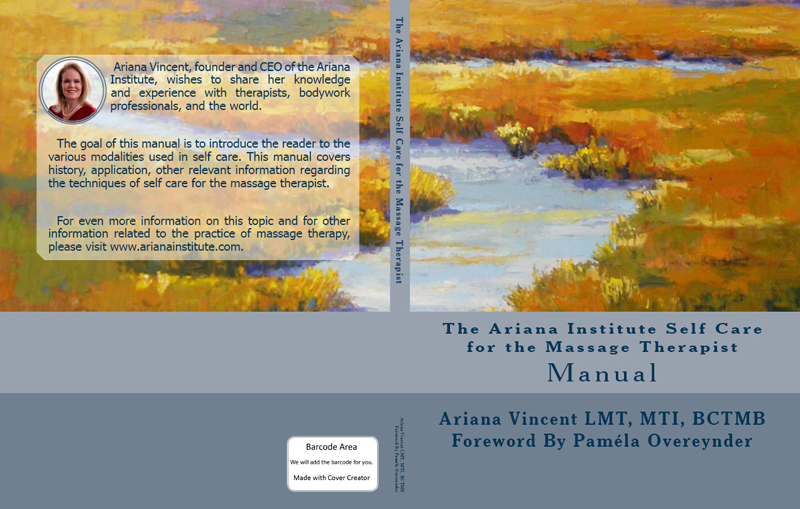
The Ariana Institute’s Self Care for the Massage Therapist Manual is part of a series of massage manuals that are designed to help deepen the knowledge of current massage therapists and introduce new massage therapists to the world of massage and bodywork. The Self Care for the Massage Therapist Manual features topics that are also available as NCBTMB approved online CE courses through the Ariana Institute at www.arianainstitute.com/ce-online/, including:

  • Self Care and Body Mechanics
  • Stretching and Breathing
  • Meditation as a Therapeutic Tool
  • Mindfulness in a Therapeutic Setting

Self Care_BookCoverPreview Continue reading “Meditation”

Posted in Ariana Institute, Ariana Vincent, Body Mechanics, CE Classes, continuing education, Massage Therapy, Meditation as a Therapeutic Tool, Mindfulness in a Therapeutic Setting, Personal Stories, Self Care for Massage Therapists, Stretching and Breathing, Therapy ManualsTagged , , , , , , , , , , ,

Exploring the Path of a Massage Therapy Instructor


Choosing Your Path

There are myriad ways you can configure your career as an MTI. You can work part-time or full-time, you can use your experiences as an MTI as a stepping-stone to another career, you can focus on being an MTI as a second career, you can blend teaching with your current vibrant massage therapy practice, or you can supplement your retirement income by becoming an MTI. There are opportunities to work as an independent massage therapy instructor like I do, you can work as an instructor at an established massage therapy school, and/or you can work for a nationwide company that provides massage therapy classes throughout the U.S. Continue reading “Exploring the Path of a Massage Therapy Instructor”

Posted in Advanced Massage Techniques, Ariana Institute, Ariana Vincent, CE Classes, continuing education, Massage Educators, Massage Therapy, Massage Therapy Instructor, Medical Massage, Mind-Body, NCBTMB, Practice Building, Self Care for Massage Therapists, Spa Techniques

Mindfulness

The Ariana Institute’s Self Care for the Massage Therapist Manual is part of a series of massage manuals that are designed to help deepen the knowledge of current massage therapists and introduce new massage therapists to the world of massage and bodywork. The Self Care for the Massage Therapist Manual features topics that are also available as NCBTMB approved online CE courses through the Ariana Institute at www.arianainstitute.com/ce-online/, including:

  • Self Care and Body Mechanics
  • Stretching and Breathing
  • Meditation as a Therapeutic Tool
  • Mindfulness in a Therapeutic Setting

Self Care_BookCoverPreview Continue reading “Mindfulness”

Posted in Ariana Institute, Ariana Vincent, Body Mechanics, CE Classes, continuing education, Massage Therapy, Meditation as a Therapeutic Tool, Mindfulness in a Therapeutic Setting, Personal Stories, Self Care for Massage Therapists, Stretching and Breathing, Therapy ManualsTagged , , , , , , , , , , ,

Stretching and Breathing

The Ariana Institute’s Self Care for the Massage Therapist Manual is part of a series of massage manuals that are designed to help deepen the knowledge of current massage therapists and introduce new massage therapists to the world of massage and bodywork. The Self Care for the Massage Therapist Manual features topics that are also available as NCBTMB approved online CE courses through the Ariana Institute at www.arianainstitute.com/ce-online/, including:

  • Self Care and Body Mechanics
  • Stretching and Breathing
  • Meditation as a Therapeutic Tool
  • Mindfulness in a Therapeutic Setting

Self Care_BookCoverPreview Continue reading “Stretching and Breathing”

Posted in Ariana Institute, Ariana Vincent, Body Mechanics, CE Classes, continuing education, Massage Therapy, Meditation as a Therapeutic Tool, Mindfulness in a Therapeutic Setting, Personal Stories, Self Care for Massage Therapists, Stretching and Breathing, Therapy ManualsTagged , , , , , , , , , , ,

Self Care for Massage Therapists

The Ariana Institute’s Self Care for the Massage Therapist Manual is part of a series of massage manuals that are designed to help deepen the knowledge of current massage therapists and introduce new massage therapists to the world of massage and bodywork.  The Self Care for the Massage Therapist Manual features topics that are also available as NCBTMB approved online CE courses through the Ariana Institute at www.arianainstitute.com/ce-online/, including:

  • Self Care and Body Mechanics
  • Stretching and Breathing
  • Meditation as a Therapeutic Tool
  • Mindfulness in a Therapeutic Setting

Self Care_BookCoverPreview

Continue reading “Self Care for Massage Therapists”

Posted in Ariana Institute, Ariana Vincent, Body Mechanics, CE Classes, continuing education, Massage Therapy, Meditation as a Therapeutic Tool, Mindfulness in a Therapeutic Setting, Personal Stories, Self Care for Massage Therapists, Stretching and Breathing, Therapy ManualsTagged , , , , , , , , , , ,

Copyright © 2026 Ariana Institute